MLOps · By Ram ·
Why Most "AI for DevOps" Tools Fail in Production
<p>I've evaluated, piloted, or quietly removed more "AI-powered DevOps" tools than I can count — at a large financial services environment and again a...
I've evaluated, piloted, or quietly removed more "AI-powered DevOps" tools than I can count — at a large financial services environment and again at an enterprise manufacturing company. The pattern repeats. The demo is incredible. The 30-day pilot is impressive. Then production happens, and within a quarter the team has either turned the AI features off or learned to ignore them.
This isn't an anti-AI take. I build ML models for pipeline-failure prediction myself. It's a take on the gap between demo-quality and production-trusted behavior, and why that gap is wider than vendors admit.
Demos optimize for the wrong thing
A demo wins by showing the AI catching a problem a human missed. Production wins by not being wrong at 3 a.m. when a tired on-call engineer is one click away from rolling back a healthy deploy.
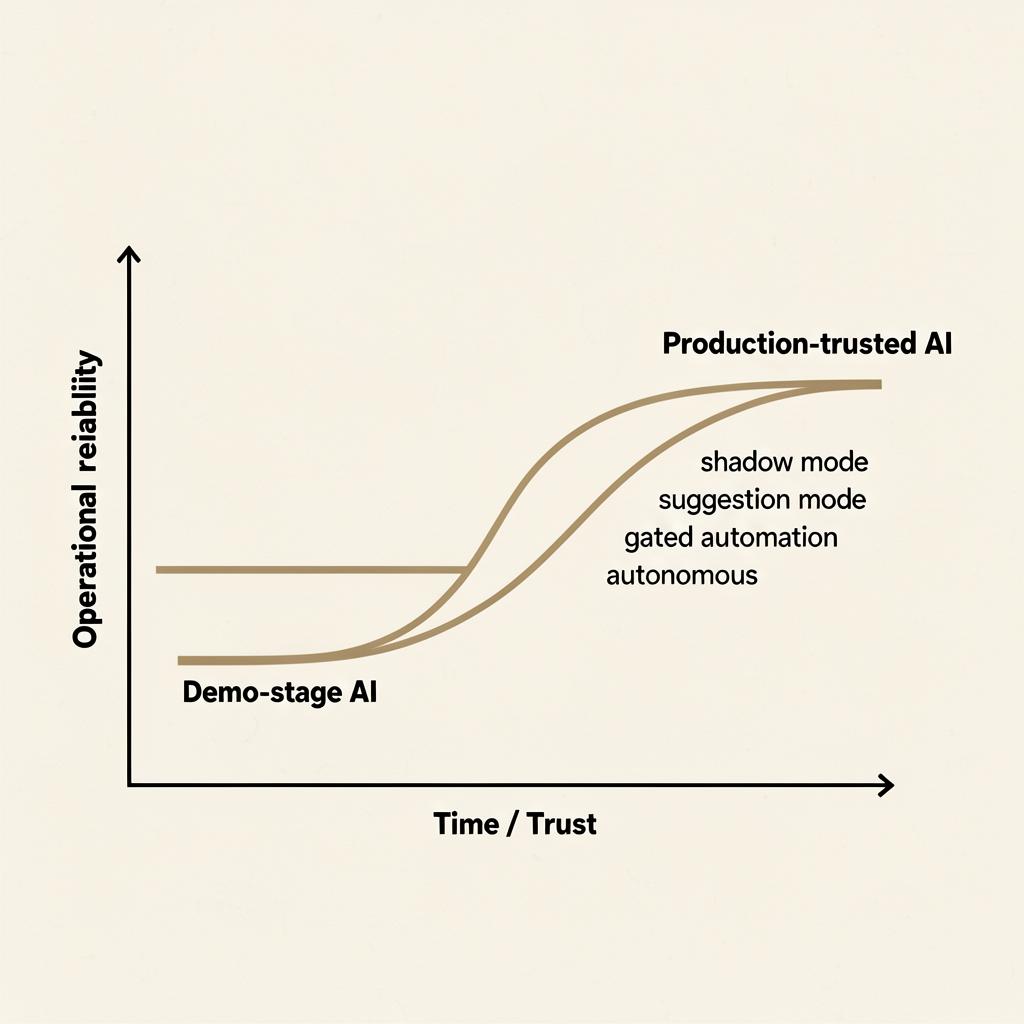
Vendors quote precision and recall on curated datasets. In production you care about a different number: actionable alerts per week, divided by total alerts per week. I have never once seen this number in a marketing deck. When I've measured it after a pilot, the honest answer is usually somewhere between 10% and 25%. That's the trust ceiling.
[IMAGE: Simple maturity-curve diagram — demo-stage AI tooling vs production-trusted AI tooling]
False positives cost more than vendors say
An auto-remediation tool that's right 95% of the time sounds great. Run it 200 times a month and you've taken 10 wrong production actions. In a regulated environment, that's a postmortem, an audit trail conversation, and a permanent reduction in everyone's willingness to let the tool act again. One bad auto-remediation undoes six months of earned trust.
The math on predictive alerts is similar. A "predicts incidents 20 minutes early" feature with a 15% false-positive rate, fired into a busy on-call rotation, becomes background noise within two weeks. The on-call engineer isn't being lazy. They're calibrating to the signal-to-noise ratio they actually observe, which is the right thing to do.
The trust deficit is asymmetric
This is the part most product teams underweight: trust is built linearly and lost exponentially. If the AI tool is correct 50 times in a row, the on-call still verifies the 51st. If it's wrong once in a meaningful way, the next 20 correct calls are still met with skepticism. The asymmetry is rational — the cost of a verified-correct alert is small, the cost of trusting a wrong one is large — and no amount of "but our accuracy is 94%" marketing fixes it.
What "good" would actually look like
I don't think AI in incident response is a bad idea. I think the design constraints have been wrong. To earn trust, an AI tool needs:
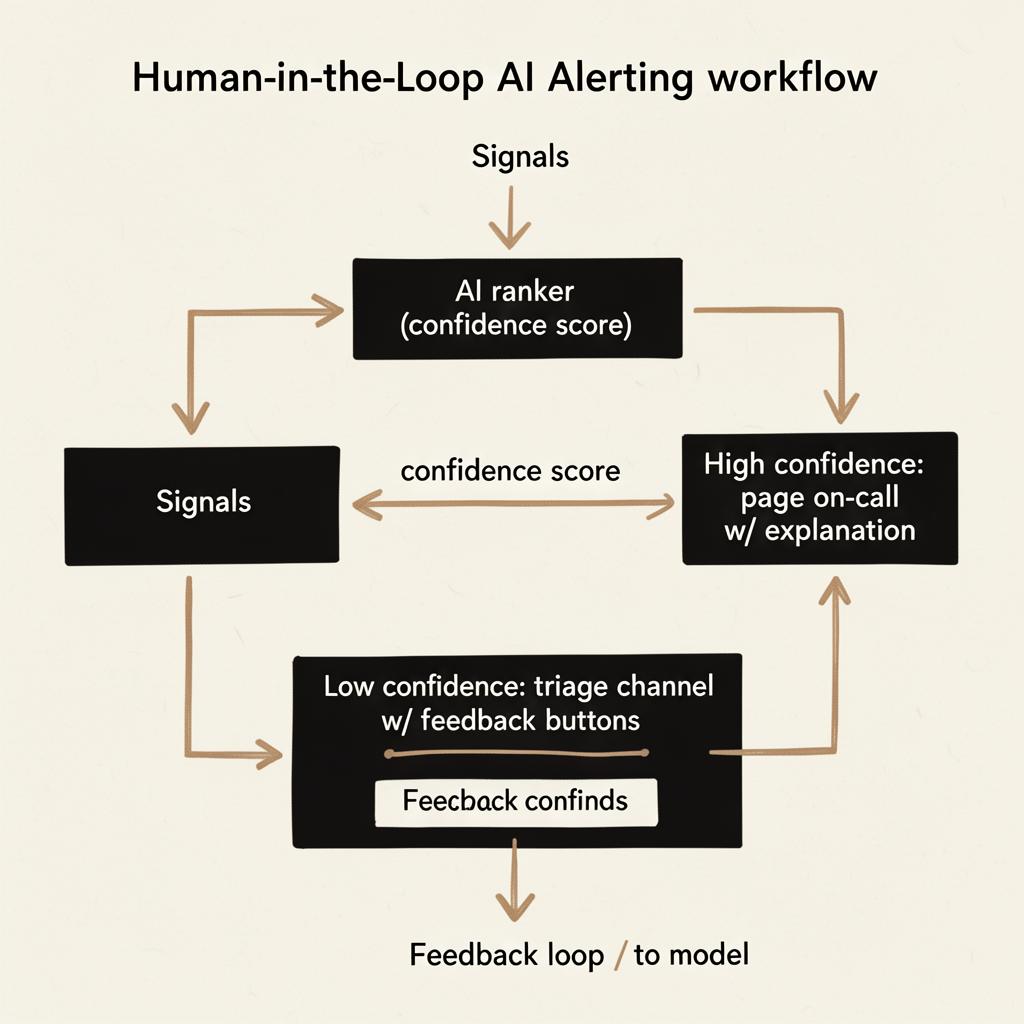
Explainability that holds up under stress. Not SHAP values. A plain-English statement: "I'm flagging this because the p99 latency on service X has been climbing for 18 minutes and the last three times this pattern preceded a database failover." If you can't write that sentence, the model isn't ready for production.
Gradual rollout modes built in. Shadow mode (logs decisions, takes no action) → suggestion mode (proposes, human approves) → gated automation (acts only on a whitelisted runbook subset) → autonomous (rare, narrow, reversible). Most tools ship in mode 4 by default. They should ship in mode 1.
Human-in-the-loop feedback that closes the loop. Every dismissed alert should be a labeled training example. Most tools collect this and do nothing with it. The on-call rotation is a free, expert-labeled, real-time data source. Use it.
[IMAGE: Diagram of a human-in-the-loop AI alerting workflow]
Where I disagree with the conventional pitch
The standard vendor framing is that AI will "augment" on-call by triaging noise. In practice the on-call's bottleneck isn't triage — it's diagnosis. Triage I can do in 30 seconds with a decent dashboard. Diagnosis is where the 45-minute meantime-to-resolve lives. An AI that ranks alerts by likely severity doesn't help me much. An AI that surfaces "three similar incidents in the past 90 days were caused by the same misconfigured proxy, here are their postmortems" would change my night.
That second product barely exists yet, and that's where I think the actual frontier is — not autonomous remediation, but institutional memory at the moment of failure. I wrote more about that idea in Building an Organizational Failure Memory for CI/CD. For a grounded read on the production-ML failure modes underneath all this, Google's Hidden Technical Debt in Machine Learning Systems paper still holds up. See also What I Learned Building an ML Model to Predict CI/CD Pipeline Failures.
Honest admission: I don't have a clean answer for what's enough explainability. "Plain-English reason" sounds nice and is hard to define crisply enough to ship. That part is still unsolved for me.